
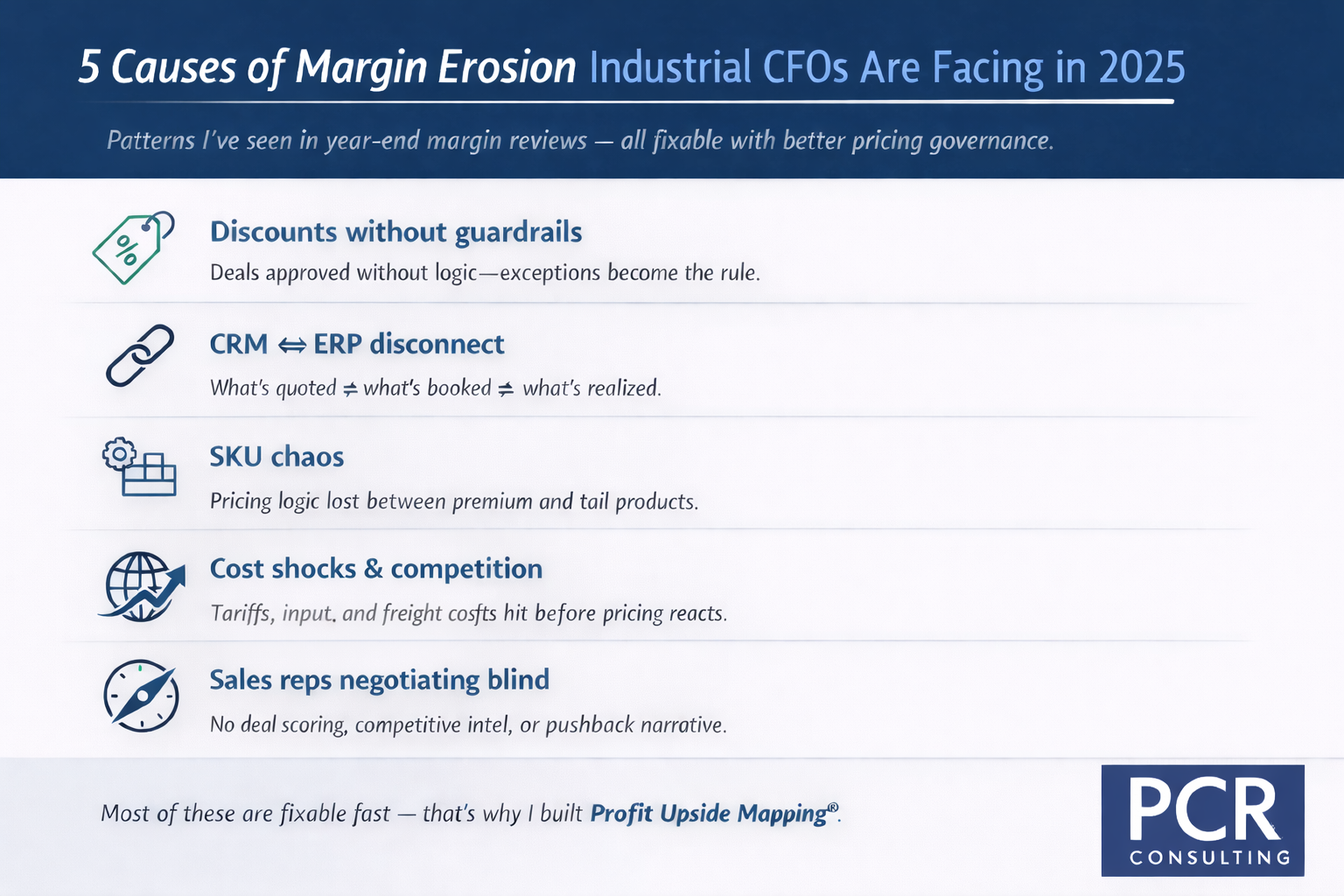
Margin erosion in industrial B2B businesses rarely occurs overnight. Instead, profitability gradually weakens through a series of small commercial and pricing breakdowns that accumulate over time.
Across many industrial companies, these issues often include uncontrolled discounting, limited pricing transparency, disconnected sales and operational systems, and delayed reactions to changes in input costs or competitive dynamics. While each issue may appear minor individually, together they can significantly reduce realized margins across customers, products and regions.
Understanding these hidden profit leaks is the first step toward restoring pricing power and improving commercial performance.
What IS Profit Upside Mapping® and why does it work so fast?
Traditional pricing projects rarely move the needle fast enough.
Profit Upside Mapping® was built to change that.
The Problem with Traditional Pricing Work
Most pricing projects follow this path:
• 2-month diagnostic phase
• Build a new pricing model or system
• 3-6+ month rollout (limited sales enablement)
• Hope adoption happens
Timeline: 12+ months
Result: diluted impact by the time it lands
Team buy-in: low (top-down, disconnected from sales reality)
For industrial SMEs fighting volatile costs, tariff shocks, and shrinking margins, that’s too slow.
How Profit Upside Mapping® Works
It starts with a 3–4-week diagnostic designed to answer 5 questions:
1. Where are we losing pricing power?
• Heat map by customer, product, region, or sales team
• Finds discount variance, tail unprofitability, premium underpricing
2. How much EBIT upside is there?
• Quantifies recoverable margin (typically +1–3pts)
• Separates “easy wins” from “structural fixes”
3. What are the 2–3 quick wins?
• Tactical moves executable in 30–60 days
• Examples: tighter approvals, surcharge enforcement, deal “situation rooms”
4. Are tariff / cost pass-throughs working?
• Competitive alignment check
• Price increase effectiveness review
5. What’s the 12–16-week roadmap?
• Prioritized action plan
• Drumbeat and implementation tracking
What Makes It Different
• Collaborative – commercial teams involved from day one
• Data-light – works with existing ERP/CRM data
• Focused – targets the 20% of issues driving 80% of leakage
• Actionable – decision support and tracking
• Fast – first wins in weeks, not quarters
Why It Works for Industrials
Margin leakage challenges here are often operational. Typical root causes:
• Discount discipline broke down
• Systems don’t talk to each other
• SKU positioning outdated
• Cost pass-through lagged
• Sales enablement gaps widened
Fix those 5 things, and you quickly recover 1-3pts of EBIT.
Case Example
A €200M construction materials company implemented 3 quick wins:
• Tightened discount approvals
• Realigned freight surcharges
• Established a Situation Room
Result: +1.5pts margin improvement in 90 days.
That’s Profit Upside Mapping®
A margin recovery sprint – and often, the first step toward pricing excellence.
Key takeaway
Margin erosion is rarely the result of a single pricing decision. More often it reflects structural weaknesses in pricing governance, sales processes and commercial transparency.
The encouraging part is that many of these issues can be diagnosed quickly. A focused pricing assessment often reveals that a meaningful share of lost margin can be recovered through targeted commercial improvements before launching a broader pricing transformation.
Curious to see how much margin you could recover?
TExt me for the 1-page Profit Upside Mapping® framework (co-developed with Dominik Endler, PhD) or comment “MAP” below and I’ll send it to you.