
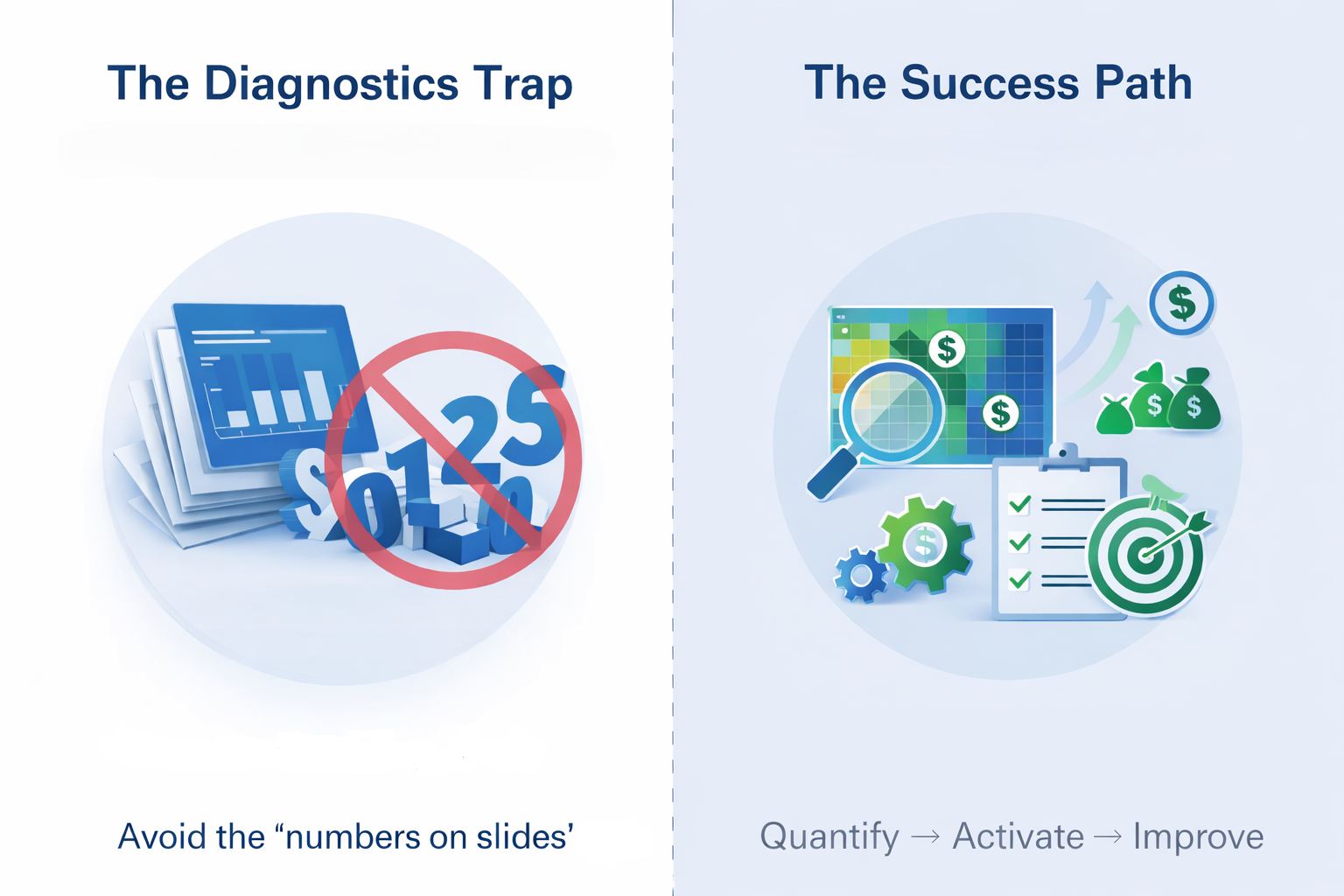
Many companies recognize that pricing holds significant EBIT potential, often 1–3 margin points recoverable within months. Yet when pricing transformations begin, leadership teams worry that diagnostics will produce analysis rather than commercial impact.
Across manufacturing and industrial sectors, margin pressure rarely stems from a single strategic issue. Instead, it results from a combination of pricing execution gaps: discount discipline breaking down, limited transparency on where pricing power exists, and slow translation of insights into action.
Successful pricing transformations start differently. The diagnostic phase must activate the organization and deliver immediate commercial improvements, not just strategic recommendations.
Turning pricing diagnostics into commercial activation
„We don’t want a five-week pricing study that ends in PowerPoint.“
I heard this again from a CEO earlier this week.
Leadership teams are increasingly skeptical of pricing diagnostics that produce analysis without tangible commercial impact.
The real challenge isn’t the analysis itself. It’s how quickly insights translate into action.
Here’s what separates diagnostics that deliver from those that collect dust:
1. Transparency on Where Margin Leaks
Before changing prices, companies need clarity on where pricing power truly exists.
Most leadership teams can’t answer basic questions:
- Which customers are destroying value after full freight and allocation?
- Where is discount variance across regions hitting 10–15 points?
- Which premium SKUs are priced like standard products?
- Where did competitors react to cost shocks faster?
Without this transparency, pricing discussions remain abstract. Sales defends relationships. Finance demands higher margins. Nobody knows which deals actually matter.
What works: A pricing power heat map by customer, product, and region, built from existing CRM and ERP data in 2–3 weeks. This makes visible:
• price realization by customer and product
• discount behavior and regional variance
• profit pools across products, spare parts and services
• where premium offerings are systematically underpriced
Without this transparency, pricing discussions remain abstract.
2. Translate Insights Into Immediate Commercial Actions
Diagnostics must produce executable measures, not structural wish lists that require 12-month transformation programs.
Typical quick wins include:
- Tighten discount guardrails: 3-tier approval system (0–5% / 5–10% / >10%) with clear escalation
- Reprice mispriced SKUs: Correct 20–40 premium and tail products where pricing drifted
- Close surcharge gaps: Address tariff and freight pass-through misalignments
- Make targeted adjustments: Price increases in segments with clear headroom and low competitive threat
Many companies recover 1 to 2 margin points within few months through these actions alone, before any strategic transformation begins.
3. Establish Governance and Sales Enablement
Pricing improvements only stick when the organization changes how pricing decisions are made.
This often requires:
• clear pricing governance and approval logic
• deal scoring and negotiation guidance for sales
• visibility into margin realization across regions and reps
• alignment between CRM data and what actually lands in the P&L
Without these mechanisms, organizations gradually fall back into old patterns.
Key takeaway
Pricing diagnostics should not end with analysis. They should trigger action.
The most effective pricing transformations combine rapid transparency, immediate commercial activation, and clear governance. When diagnostics are designed this way, pricing improvements translate into measurable EBIT impact within months rather than remaining theoretical recommendations.
The most effective pricing transformations combine:
– Rapid transparency on where margin leaks, where pricing power exists
– Immediate activation by 3–5 quick wins executable in 30–90 days
– Clear governance for improvements to stick beyond the first quarter
When diagnostics are designed this way, pricing improvements translate into measurable EBIT impact within months, not theoretical recommendations that remain in a PowerPoint deck.
Most organizations already have the data required to begin this process. The challenge is not data availability but translating insights into actionable commercial measures.