
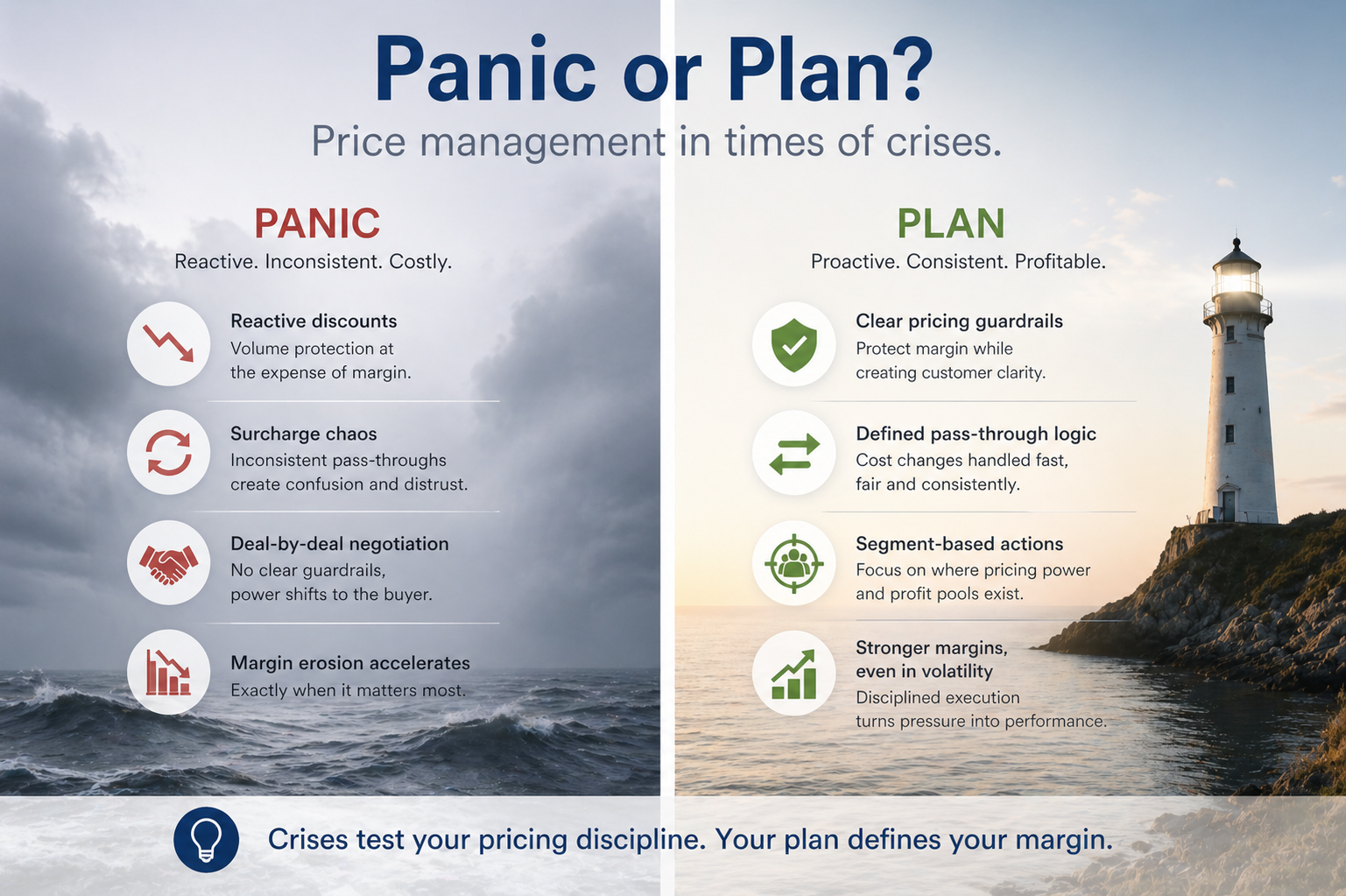
Industrial companies are currently facing a volatile environment: fluctuating energy costs, supply chain disruptions and softening demand. In such situations, pricing often becomes reactive rather than strategic.
Across many manufacturing and chemical businesses, margin pressure is not primarily driven by volume decline, but by inconsistent pricing decisions made under uncertainty. Discounts increase, surcharges are adjusted frequently, and sales teams negotiate without clear guardrails.
Understanding how pricing behaves in times of crisis is critical. Companies that maintain pricing discipline and act with a clear plan are significantly better positioned to protect margins and navigate volatility.
When pricing shifts from plan to reaction
Energy costs swing.
Demand softens.
Supply chains break.
And suddenly, pricing becomes reactive.
Typical patterns include:
• Discounts increase “to protect volume”
• Surcharges are introduced, removed and reintroduced
• Sales negotiates deal by deal without clear guardrails
In many industrial companies, crisis pricing follows a predictable pattern:
First panic, then local optimization, but rarely a clear plan.
This accelerates margin erosion exactly when it matters most.
What resilient organizations do differently
More resilient organizations separate signal from noise and act early.
They focus on three key questions:
- Where does pricing power still exist despite the crisis?
- Which cost changes must be passed through immediately and where can they be absorbed?
- Which customers, products and segments truly matter for margin?
Based on this, they act consistently rather than reactively.
Key takeaway
Crises do not reduce the importance of pricing discipline…they increase it and make gaps visible.
Companies that maintain a clear pricing plan, define guardrails and act consistently are better able to protect margins, even in highly volatile environments.
Your plan defines your margin.