
Many industrial companies close the fiscal year believing performance was stable: revenue targets were achieved, volumes remained steady and cost discipline was maintained. Yet when the final numbers are reviewed, margins have quietly declined by one to three percentage points.
In many cases, this margin erosion is not caused by a single strategic mistake but by a series of operational pricing and commercial execution issues. Across recent year-end margin reviews in manufacturing and industrial sectors, several recurring patterns emerged that systematically weaken pricing power and profitability.
The encouraging part is that these issues are often identifiable and correctable relatively quickly through targeted pricing diagnostics and tactical improvements.
Five common profit leaks in industrial B2B pricing
Many industrial CFOs just closed the books…and discovered that 2 points of margin silently eroded.
– Revenue may have hit the target
– Volume was stable
– Costs were managed
But still, margin dropped 1.5-2.5 points. Where did it go?
I just finished year-end margin reviews…with a consistent pattern of challenges:
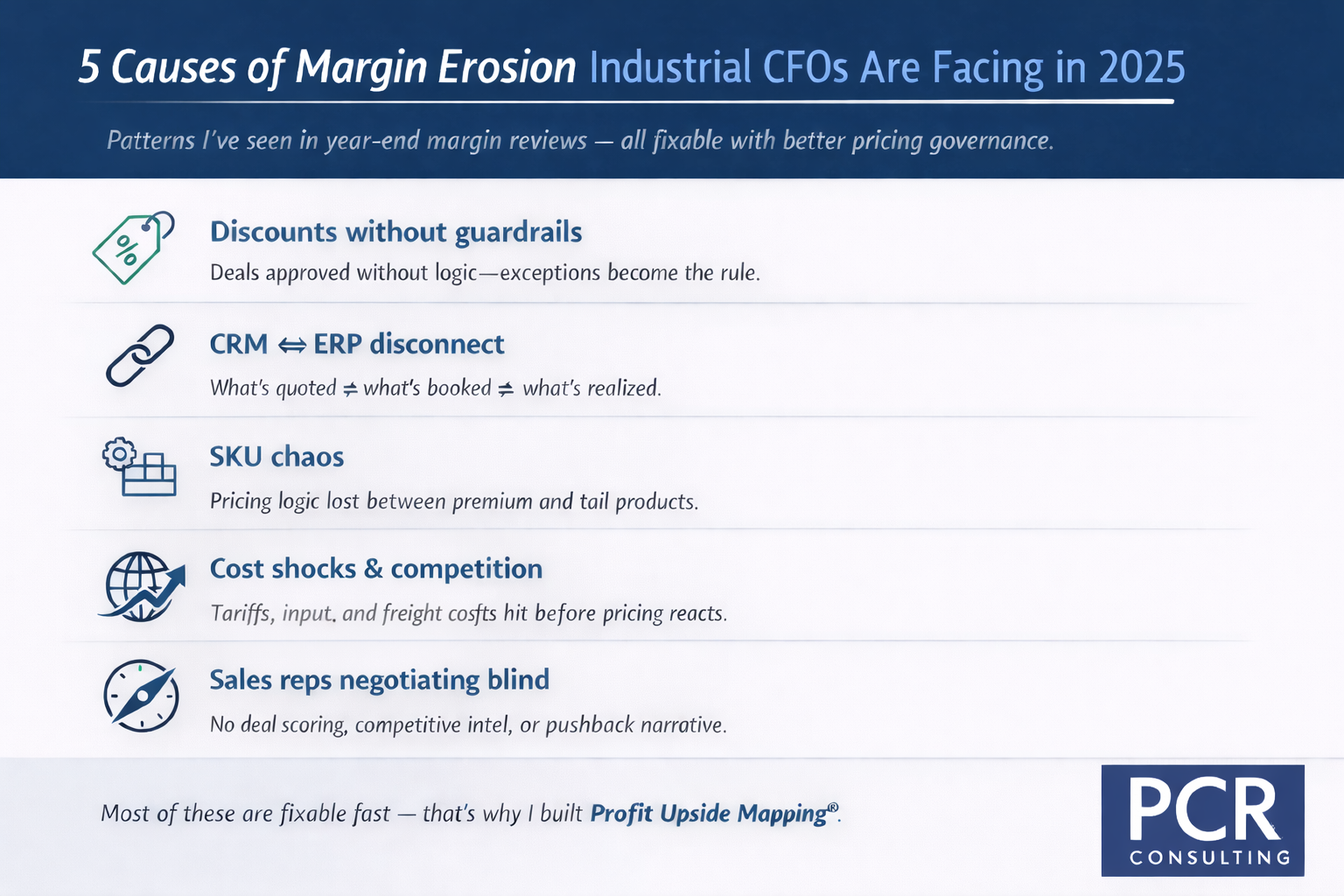
1. Discounts without guidance and guardrails
No deal scoring, no target prices or discounts, no approval logic that actually works. Exceptions become the rule.
2. CRM ↔ ERP disconnect
What sales quotes ≠ what operationally happened ≠ what margin actually lands. Most companies analyze deals after the margin is gone.
3. SKU chaos
No clear price logic: premium products underpriced, tail products bleeding margin. Nobody has visibility – on product performance or customers’ purchasing behaviors.
4. Cost shocks & competitive shifts
Tariffs change, input costs swing, freight doubles. Meanwhile, competitors exploit the chaos to gain share. Pricing responses take way too long.
5. Sales reps negotiating blind
They don’t know which deals matter and why, they can’t defend prices and surcharges. No deal scoring, no competitive intel, no prepared responses to pushback
At least three, sometimes all of these occur over and over again in B2B, e.g., in manufacturing, specialty chemicals, components, and construction materials; other issues may come on top.
The result: 1-3 points of margin melting away every quarter, while leadership struggles to pinpoint why.
The good news: Most of this is fixable fast!
That’s why I developed Profit Upside Mapping®: a 3–4-week diagnostic that uncovers:
– Where pricing power is leaking by customer and product (segments), region, rep
– How much margin is recoverable (typically 1-3pts)
– The 2-3 highest-impact quick wins to immediately implement
– Surcharge and tariff misalignments to urgently address
– A 12–16-week tactical roadmap and strategic initiatives
Recent clients have recovered margin substantially within a quarter, without major system changes and without losing customers.
Key takeaways
Margin erosion in industrial businesses rarely happens overnight. Instead, it results from a combination of small commercial and pricing breakdowns: uncontrolled discounting, poor pricing transparency, disconnected systems and slow reactions to cost or market changes.
The important insight is that many of these profit leaks can be identified quickly. A focused pricing diagnostic often reveals that a significant share of lost margin can be recovered through targeted commercial improvements before any large-scale pricing transformation is required.
Want to see where your margin is leaking? DM me for the Profit Upside Mapping® diagnostic framework (1-pager, co-developed with Dominik Endler, PhD)—or comment below if you’re seeing these patterns too.
Tools such as structured pricing diagnostics or profit-leak assessments help companies identify where pricing power is leaking and prioritize the highest-impact corrective actions.